Related articles
What Pokemon GO tells us about uberization
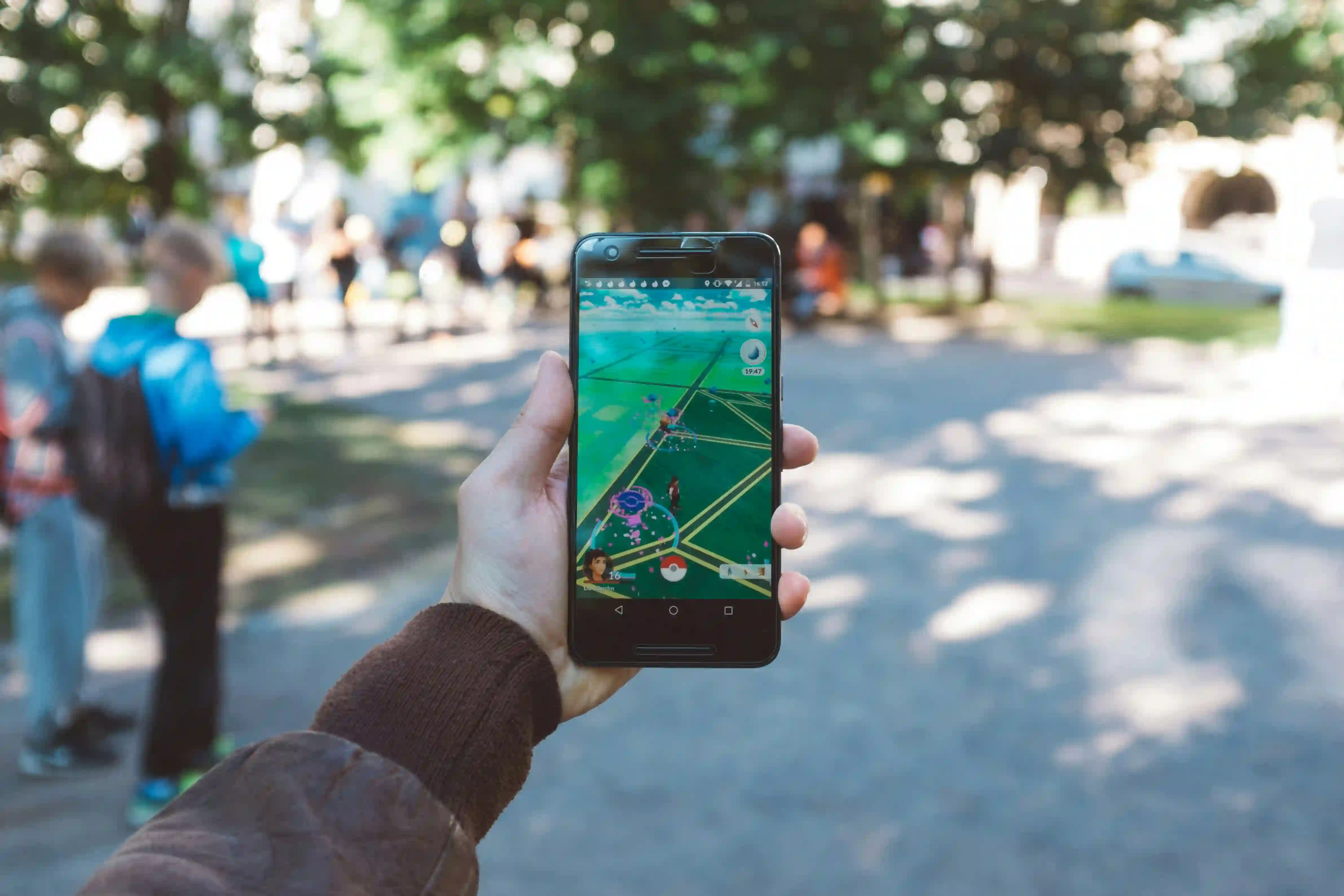
While the frenzied enthusiasm aroused by Pokemon Go in its early days has subsided somewhat, the game has nevertheless established itself as a reference in mobile video gaming and still generates considerable revenue: over half a billion dollars in revenue since its launch in July 2016!
We are well aware that there are several definitions of uberization. For this article, we will just talk about uberization as the process by which radical innovation will destabilize a sector and its actors. By questioning the functioning of established players in the video game industry, Pokemon GO has successfully uberized its sector.
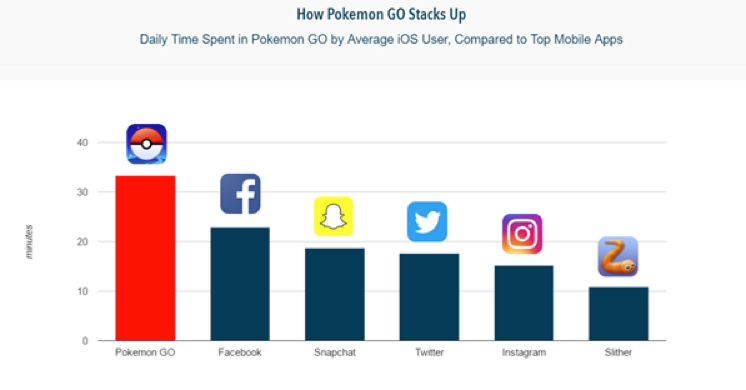
In August 2016, we spent more time playing Pokémon GO than using other apps on the App Store.
The Pokémon GO phenomenon proves once again that in recent years, startups are at the origin of the great innovations of capitalism. Niantic has shaken up the mobile video game industry by introducing augmented reality into its products — first with Ingress in 2012 and then with Pokemon GO today.
But innovation is also happening in the business model. Of course Pokemon GO contains integrated purchases but in the long run, a significant part of the profits will come from advertising for local businesses. McDonald's has already entered into a partnership in Japan so that three hundred arenas are located in their restaurants.
Finally, the major innovation brought by Pokemon Go to the world of mobile video games is its ability to mobilize all the functionalities of our smartphones to produce an exceptional gaming experience. We use geolocation to move around, we catch our Pokémons with our camera, we relay our captures via social networks... In short, The main functionalities of our mobile phones are all put at the service of the game !
And in the video game sector, Everyone is overwhelmed : both traditional publishers who have never managed to fully adapt to the mobile market (Electronics Arts, Activision, Ubisoft etc.) and publishers specializing in mobile applications such as King (publisher of Candy Crush) or Gameloft (publisher of the Asphalt series). To convince you of this, know that Pokemon Go garnered more revenue per day in August than all other mobile applications combined!
Pokemon Lean
Pokemon GO is also proof that lean startup is currently the best way to launch a product. At its release, the game contained innumerable bugs and the servers were not in a position to manage such a flow. But the user experience was so good that players were still looking to play it. Thanks to Feedback received since the release of the game, Niantic was able to quickly fix the main bugs and get new ideas to improve the game.
It should be noted that this strategy is deliberate and that it is not a sign of poor preparation for the release of the game. Before its generalization, Niantic tested its new radar in the city of San Francisco and adjusted it by small touches, until it was optimal and ready to be extended to the rest of the world. We test on a sample, we get feedback, we improve and we start again until we are satisfied with the final functionality.
The actors of this uberization
Niantic was founded in 2010 as an internal subsidiary of Google. John Hanke has been at the helm since its launch. Previously, it was The instigator of Google Earth and managed Google's Geo division for a few years. Niantic was created with the aim of finding new products that make the most of the group's mapping services. The startup first launched Field Trip, a service that sends notifications about points of interest near us. Then, gradually, the startup focused its activity around mobile video games.
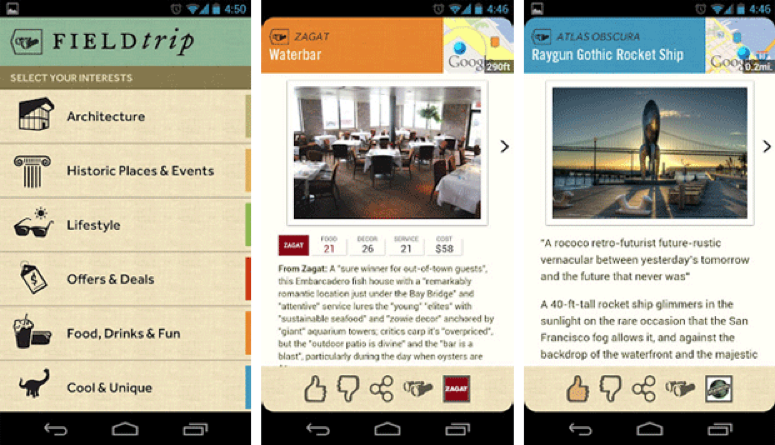
Mobile screenshots of Niantic's first app, Field Trip
In 2012, Niantic released the group's first video game. Ingress is an alternate reality game that involves two teams competing to control portals represented on a collaborative map. These portals are created as players come up with proposals (who submit ideas for locations with a photo and a description).
It should be understood that Niantic used Ingress as a technological and economic glue to build Pokemon GO. Thus, the arenas and the Pokéstops are located in the same places as the Ingress portals.
Initially, Ingress thought about monetizing its product differently, refusing in-app purchases that greatly alter players' user experiences. Their idea was to establish advertising partnerships with major brands (AXA, Mitsubischi, Motorola or Vodafone) so that they can have their own customizable portal.
But in August 2015, when Google was restructured around the Alphabet holding, the startup was forced to take off and find new sources of income. Niantic is then forced to provide Ingress with a traditional integrated purchasing system.
Three months after becoming independent, Niantic raised 30 million dollars from Nintendo, The Pokemon Company and Google (20 million granted directly and 10 million more if the startup achieved certain goals). At the beginning of 2016, Niantic received an additional 5 million euros. These funds were used to develop and launch Pokémon GO.
The success of Trinity: the brand (Pokemon), the big companies (Google and Nintendo) and the startup (Niantic)
These three players uberized the video game sector by proceeding in new ways to create Pokemon GO. Both Nintendo and Google are investors, who provide the startup with their numerous resources: Niantic enjoyed almost total freedom to develop its game.
For Nintendo and the Pokemon Company, this operation was a winning bet allowing them to take their first steps in the mobile world. Until then, only Nintendo had the right to develop video games based on Pokémon. Instead of running the risk of entering a very specific video game sector, the Japanese firm preferred to field a few million and entrust this mission to an expert. With Pokémon Go, Nintendo is reaching the billion people who play on mobile without in-depth knowledge of it.
Since its creation, Niantic was a business unit independent of the rest of Google. From then on, it had two exit strategies: either it reintegrated its technology into the group, or it separated from it permanently. There are two main reasons why Niantic wanted to take off on its own:
- The startup was more like A video game publishing company than a company working around Google services,
- Google wants to maintain its neutrality in its activities, which are for the majority of platforms (Play Store, Google Maps) on which anyone can work without some being advantageous. To launch Pokemon GO, Niantic needed to join forces with Nintendo, which went against Google's desire for neutrality.
But this somewhat particular separation goes Going backwards from Google's current strategy who jealously guards supported and incubated projects. Indeed, Alphabet wants to be a flexible structure capable of housing different businesses and cultures so as not to lose potential sources of income.
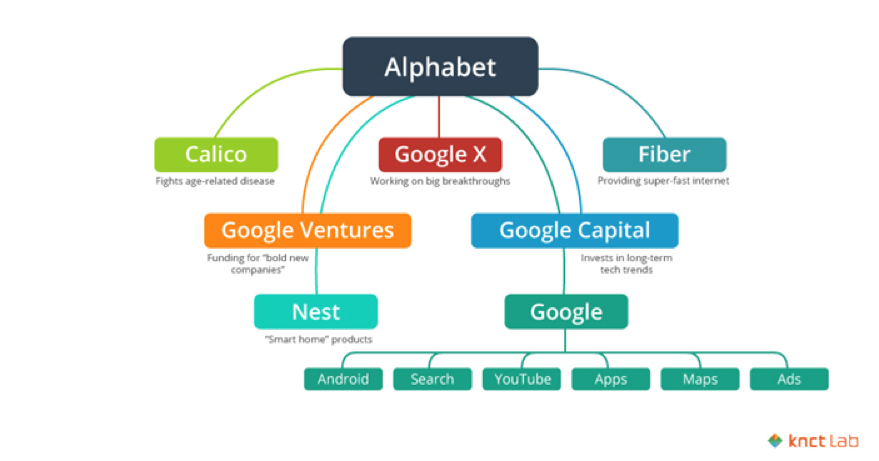
The structure of Alphabet, the Google holding company
In short
With Pokemon GO, Niantic has uberized the video game sector by bringing radical innovations, whether in the user experience, in the business model or in the way the application is built.
Today, most of the major disruptive innovations are introduced by startups. The lean startup mode helps them structure their innovation process through the create-test-learn cycle.
If a large group wants to stay at the forefront of innovation, we see two effective solutions: investing in startups like Nintendo, hosting a “startup studio” like Google.